Glycerin: The Ingredient Nobody Talks About
Glycerin appears in more skincare products than almost any other ingredient, yet it rarely gets its own moment. That's partly because it's cheap, unsexy, and difficult to build a marketing campaign around — but it's also one of the most reliably useful things you can put on your skin.

Glycerin doesn’t get talked about the way niacinamide or retinol does. There’s no trending TikTok concentration debate, no “glycerin slugging” moment, no serums with a bold percentage on the label. And yet it’s probably sitting in more of your products than any single trendy active — quietly doing work that most people credit to whatever headline ingredient shares the label.
That anonymity is partly the point. Glycerin is too cheap and too well-understood to generate marketing excitement, which means it gets overlooked in exactly the conversations where it deserves a mention.
What it actually is
Glycerin — also called glycerol — is a small, simple molecule: a sugar alcohol with three hydroxyl groups, each of which loves water. It’s been used in skincare formulations since at least the mid-20th century, and in pharmaceutical preparations for considerably longer. It’s water-soluble, colourless, odourless, and about as unexciting as a molecule gets on paper.
What makes it useful is that it’s a humectant — it draws water to itself and holds it there. That sounds simple, and mechanistically it is, but the practical effect of doing that well, consistently, in a stable and well-tolerated format, is more valuable than most of the flashier claims on the shelf.
How it works (and the humidity question)
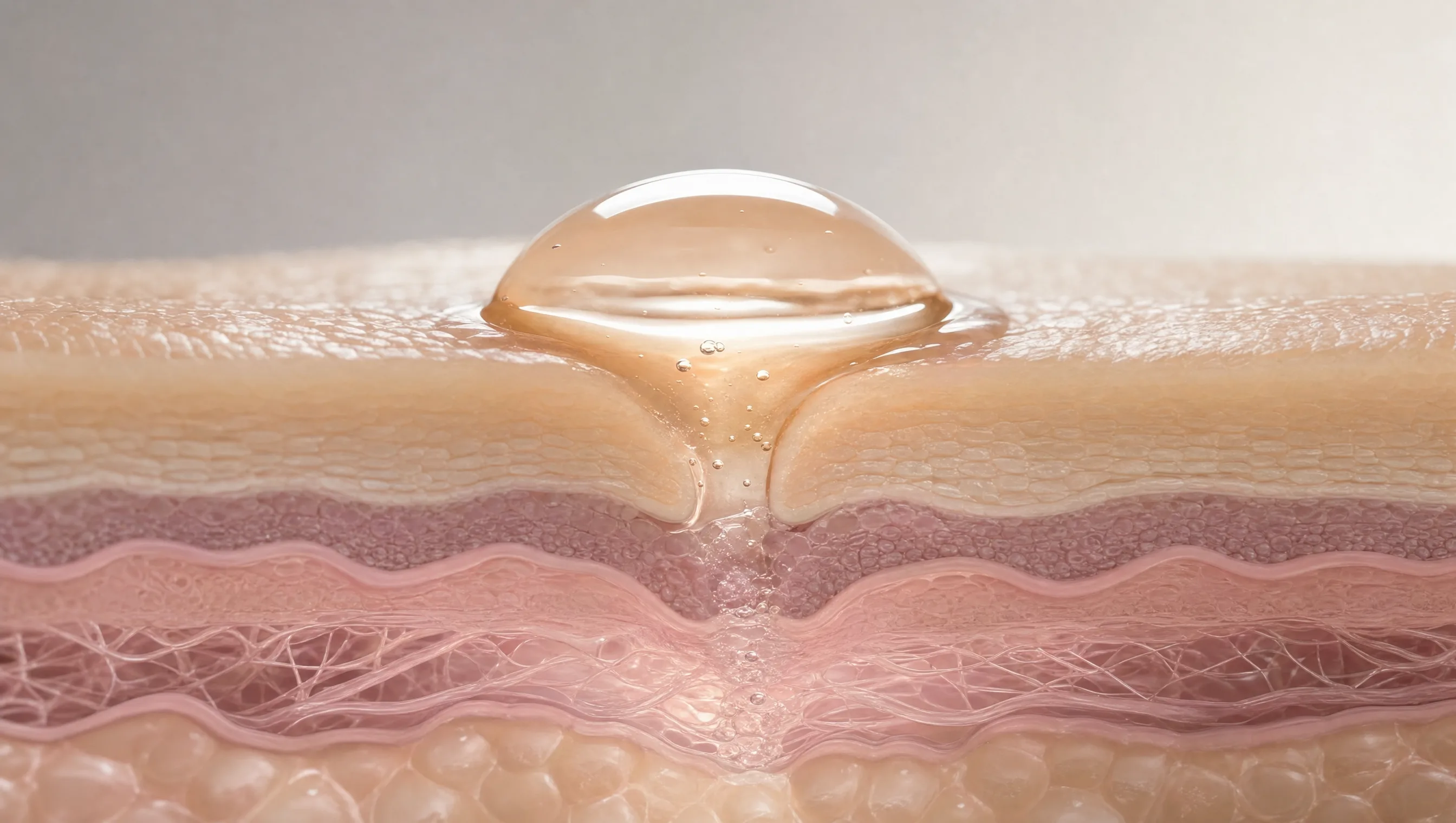
Glycerin pulls moisture into the outer layers of skin from two directions: from the environment if there’s humidity available, and from the deeper dermis regardless. It also appears to support the skin’s own natural moisturising factor (NMF) — the collection of water-attracting molecules your skin already produces — rather than just sitting on top as a passive layer.
There’s a persistent worry, especially in online skincare communities, that humectants like glycerin “pull moisture out of your skin” in dry climates. The concern isn’t entirely baseless in theory — in very low humidity, a humectant on the surface could theoretically draw water upward from deeper layers faster than the environment replaces it. But in practice, this doesn’t seem to be a meaningful problem with glycerin at the concentrations used in finished products. Studies in low-humidity conditions still show improved skin hydration with glycerin-containing formulations, not worsened dryness.
The caveat is that pure glycerin — undiluted, straight from the bottle — is a different story. At very high concentrations it can feel tacky, and without a surrounding formulation to help seal moisture in, the theoretical concern has more relevance. But nobody is (or should be) using neat glycerin as a moisturiser. In a well-formulated product, paired with occlusives and emollients like squalane that reduce evaporation, the humidity worry is largely academic.
What the evidence supports
Glycerin is one of the best-studied humectants in dermatological research, with a body of evidence that’s broader and more consistent than hyaluronic acid’s, even though HA gets far more attention.
Hydration. This is the core, well-supported claim. Multiple studies demonstrate that glycerin meaningfully increases skin hydration and reduces transepidermal water loss (TEWL). The effect is measurable, reproducible, and visible as softer, more supple skin. If you’re dealing with dehydrated skin — tight, dull, fine lines from dryness rather than ageing — glycerin is one of the most reliable tools available.
Barrier support. Glycerin appears to do more than just attract water. Research suggests it helps maintain the structure of the skin barrier’s lipid layers and supports the production of the cornified envelope — the tough outer shell of dead skin cells that keeps water in and irritants out. This is a subtler benefit than raw hydration, but it’s part of why glycerin-containing products tend to improve skin condition beyond just making it feel temporarily moist.
Wound healing context. In dermatological research, glycerin has shown properties that support the skin’s natural repair processes. This isn’t a claim about treating wounds with moisturiser — it’s background evidence that glycerin does more than passively sit on skin. It interacts with the biology in modest but real ways.
Texture and appearance. Well-hydrated skin looks and feels better — smoother, more even, with less visible fine dehydration lines. Glycerin delivers this consistently, which is part of why formulators reach for it even when the product’s hero story is about a different ingredient entirely.
How it compares to hyaluronic acid
This is the obvious comparison, since both are humectants marketed for hydration. The honest answer is that glycerin is the more reliably useful of the two in most formulations, despite getting a fraction of the attention.
Glycerin is a tiny molecule — 92 daltons — which means it penetrates the outer skin layers easily and gets to work where hydration matters most. Hyaluronic acid is enormous by comparison, and while low-molecular-weight forms can penetrate more effectively, the large-molecule versions that dominate many products mostly sit on the surface creating a temporary film.
Glycerin is also dramatically more stable in formulation, cheaper to use effectively, and less dependent on concentration games. HA isn’t bad — it’s a perfectly reasonable ingredient — but the gap between its marketing profile and its evidence profile is wider than glycerin’s. Glycerin has a quieter reputation and delivers more consistently. That’s not a glamorous verdict, but it’s an accurate one.
Why it’s in everything
Formulators love glycerin for practical reasons that have nothing to do with marketing:
- It’s stable across a wide pH range, doesn’t degrade with heat or light, and needs no special packaging
- It improves the texture and spread of almost any formulation
- It’s compatible with virtually every other ingredient — actives, preservatives, fragrances, sunscreen filters
- It’s cheap enough to use at effective concentrations without blowing a product’s cost sheet
- It has decades of safety data across skin types, including sensitive and compromised skin
That combination is genuinely rare. Most ingredients involve trade-offs — instability, incompatibility, irritation risk, cost. Glycerin sidesteps nearly all of them, which is why it appears in everything from budget cleansers to expensive serums and creams.
How much matters
Most moisturisers and serums contain glycerin at somewhere between 2% and 10%. The ingredient list won’t usually tell you the exact percentage, but glycerin near the top of the list (after water, typically) signals a meaningful amount.
Higher isn’t automatically better here. Concentrations above 15–20% can feel sticky and heavy on the skin, without proportionally better hydration. The diminishing returns set in earlier than you might expect, and the sensory experience matters — a product you hate wearing gets abandoned, which is worse than a slightly lower glycerin concentration used consistently.
There’s no need to seek out “glycerin serums” specifically. If glycerin is in the first five or six ingredients of a product you already like, you’re getting an effective amount. The ingredient doesn’t need to be the star to do its job.
Who gets the most out of it
Almost everyone, which is the boring but honest answer. Glycerin is one of the few ingredients where “suitable for all skin types” is genuinely accurate rather than marketing shorthand.
Dehydrated skin sees the most obvious benefit — that tight, flaky feeling that comes from insufficient moisture rather than insufficient oil responds directly to what glycerin does. Sensitive or barrier-compromised skin benefits from the barrier support and the fact that glycerin is exceptionally well-tolerated; genuine glycerin sensitivity exists but is vanishingly rare. Oily skin isn’t excluded either — glycerin provides hydration without adding oil, which is exactly what oily-but-dehydrated skin needs.
Where glycerin does less: if your skin is already well-hydrated and your barrier is intact, you won’t notice a dramatic change from adding more glycerin. It’s a maintenance ingredient at that point — keeping things ticking over rather than transforming anything. And if your concern is pigmentation, fine lines from ageing, or acne, glycerin isn’t addressing those directly. It supports a good environment for other actives and treatments to work in, but it won’t do their job for them.
Common questions
Is glycerin the same as glycerol? Yes. Glycerin is the common name used in cosmetics; glycerol is the chemical name. Same molecule.
Can I use pure glycerin on my skin? You can, but it’s not ideal. Undiluted glycerin is very thick and sticky, and without an occlusive layer over it the hydration benefit is reduced. It works better as part of a formulated product.
Does glycerin clog pores? No. It’s not comedogenic. Its water-soluble nature means it doesn’t sit in pores the way oils can.
Is vegetable glycerin different from regular glycerin? Functionally, no. Vegetable glycerin is derived from plant oils; synthetic glycerin is chemically identical. The molecule your skin sees is the same either way.
Should I avoid glycerin in dry climates? No — see the humidity section above. In a properly formulated product, glycerin improves hydration even in low-humidity environments.
The honest limitations
Glycerin won’t fix a specific skin concern. It won’t fade dark marks, reduce wrinkles from ageing, calm rosacea, or clear breakouts. It’s a hydration and barrier-support ingredient — foundational, not targeted. If you’re looking for visible change in a specific area, you need the right active for that job; glycerin just creates better conditions for it to work.
It’s also so ubiquitous that you’re almost certainly already using it. Switching to a “glycerin-focused” product from one that already contains glycerin in its top five ingredients probably won’t produce a noticeable difference. The marginal return from more glycerin, when you’re already getting a reasonable amount, is small.
And while it’s remarkably well-tolerated, “suitable for everyone” doesn’t mean “impossible to react to.” If a glycerin-heavy product irritates your skin, that’s more likely down to something else in the formula — fragrance, preservatives, essential oils — but it’s worth noting that no ingredient is truly universal.
Where that leaves you
Glycerin is the most unglamorous useful ingredient in skincare. It hydrates, it supports the barrier, it plays well with everything, it’s cheap, it’s stable, and it works. None of that is exciting enough to build a brand campaign around, which is exactly why it gets less attention than ingredients with a fraction of its evidence base.
You don’t need to go looking for it — you’re almost certainly already using it. But if you’re choosing between products and one lists glycerin high in its formula while another buries it at the bottom, that’s a genuinely meaningful difference worth noticing. The boring ingredient, in this case, is the reliable one.
This article is for informational purposes only and does not constitute medical advice. If you have concerns about your skin, consult a dermatologist or your GP.