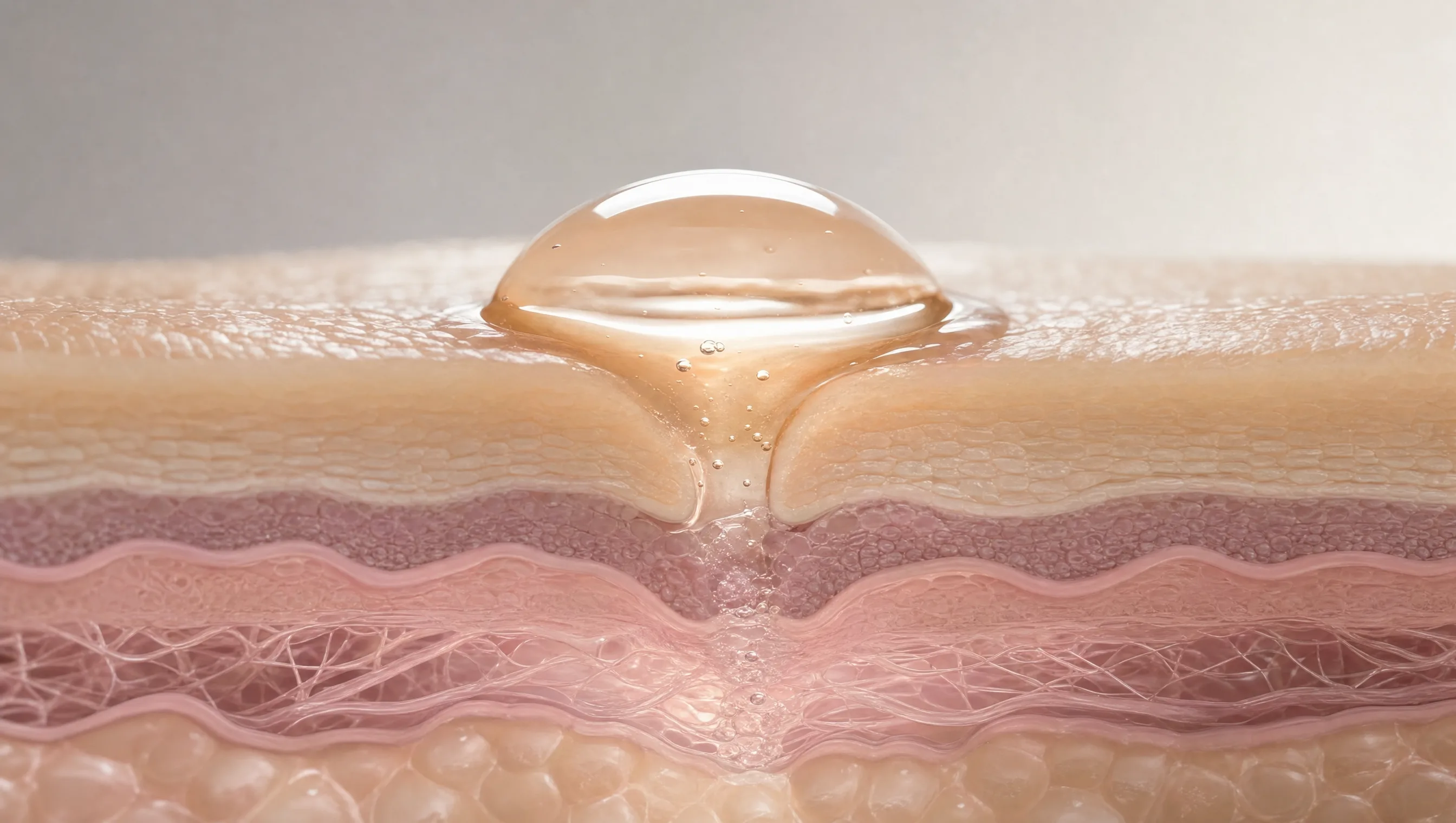
If Skin Is a Barrier, How Does Skincare Actually Work?
Skin is built to keep things out, so how can a serum change anything? The answer is that skin is selective, not sealed — and a handful of physical rules decide what gets through.

If skin’s job is to keep the outside world out, how does a £40 serum get past it? It’s a reasonable thing to wonder, and the honest answer isn’t “it doesn’t” — it’s that skin behaves less like a sealed wall and more like a checkpoint. Some things pass, most don’t, and which category an ingredient falls into is decided by a handful of physical rules that have nothing to do with how good the marketing sounds.
Selective, not absolute
The outermost layer of skin — the stratum corneum — is usually described as a brick-and-mortar structure: dead skin cells (corneocytes) as the bricks, a lipid matrix of ceramides, cholesterol and fatty acids as the mortar. It’s remarkably good at stopping water loss and keeping out pathogens, irritants and most of what the environment throws at it. But it was never built to be impenetrable — skin still needs to respond to its environment, and a limited traffic of molecules moving in both directions is part of how it does that.
The question worth asking isn’t “does anything get through”, it’s “what gets through, and how”.
What decides whether an ingredient penetrates
Three factors do most of the work.
Molecular size matters most. The widely cited 500 Dalton rule holds that molecules above roughly that weight struggle to cross the stratum corneum. Water is 18 Daltons; retinol is around 286. Most peptides used in skincare are deliberately engineered to sit under or near that ceiling — see the peptides overview for how that shapes what they can realistically claim to do.
Lipophilicity — how fat-loving a molecule is — matters almost as much. The lipid mortar between corneocytes is the main route most actives use to get anywhere, so molecules that dissolve readily into a fatty environment tend to move through it more easily than water-soluble ones do.
Concentration and formulation decide how much of an ingredient is actually available to penetrate, and how efficiently the vehicle delivers it. Two products can list the same active at the same percentage and behave completely differently, because what surrounds the ingredient changes how much of it ever reaches its target — the emulsions and oil vs water-soluble choices behind a formula aren’t cosmetic details, they’re part of the mechanism.
Three routes through
Not everything takes the same path. The intercellular route winds through the lipid mortar between cells — slower, but the most common path for well-formulated, appropriately lipophilic actives. The transcellular route goes straight through the corneocytes themselves, which means repeatedly crossing between lipid and watery environments; it’s less common but relevant for some compounds. The appendageal route skips the stratum corneum altogether by using hair follicles and sweat glands as shortcuts — a small share of total surface area, but a genuine access point, particularly for larger molecules and certain encapsulated delivery systems.
The case study: topical hormones
Steroid hormones — pharmaceutical corticosteroids, or hormone-replacement patches — are close to ideal for this kind of transit: small, highly lipophilic, and potent enough to work at very low doses. That’s why a hydrocortisone cream can calm inflammation so effectively, and why a patch can deliver oestrogen or testosterone into circulation. Nothing about the barrier is being broken here — it’s being navigated by molecules with exactly the right properties to move through it.
Why formulation is part of the science, not decoration
Understanding penetration also explains why formulation matters as much as it does. The vehicle — an anhydrous serum, an oil-in-water emulsion, a gel — changes how an ingredient interacts with the barrier. pH plays a role too; ascorbic acid needs a specific pH range for stability and effective delivery, which is one of several formulation rules that quietly decide whether an active does anything at all.
Modern delivery science has added further options: liposomal encapsulation to protect unstable ingredients while improving uptake, certain fatty acids that temporarily and safely loosen barrier permeability, and newer systems that target specific skin depths — see transdermal vs topical delivery for how far that distinction actually goes.
What it means for your routine
None of this means every product is penetrating deeply, and it shouldn’t. Plenty of skincare works at or near the surface by design — humectants pulling water into the stratum corneum, emollients smoothing gaps between cells, occlusives slowing water loss. That’s not a lesser mode of action; it’s the appropriate one for what those ingredients are meant to do.
Where penetration matters is for actives intended to influence cellular behaviour — retinoids, certain antioxidants, peptides, exfoliating acids. Those need to reach their target to do anything, which is also why a compromised barrier changes how they behave: with the mortar disrupted, actives that normally stay near the surface can suddenly penetrate further than intended, which is more often a problem than a bonus.
Common questions
Does a bigger percentage on the label mean more of it gets in? Not necessarily. Molecular weight, lipophilicity and the surrounding formulation decide how much of an ingredient actually reaches its target — a well-formulated 5% product can outperform a poorly formulated 15% one.
Why do some products seem to “sink in” faster than others? Usually formulation — thinner, more lipophilic vehicles feel like they vanish quickly. It’s not a reliable sign of how deep an ingredient is actually going, and unusually fast absorption on skin that’s normally slower to absorb products can be a sign of barrier damage rather than a good formula.
If skin barely lets anything through, why bother with actives at all? Because “barely” isn’t “never”. The ingredients with real evidence behind them — retinoids, vitamin C, certain peptides — are backed by decades of research showing they do get through in meaningful amounts when the molecule and the formulation are right.
Where that leaves you
Skin isn’t a wall and it isn’t an open door — it’s a selective barrier that lets specific molecules through under specific conditions. Understanding those conditions is what separates skincare that’s plausible on paper from skincare that has a real chance of doing what it claims. Good formulation works with that biology; ingredient lists that ignore it are asking a molecule to do something the barrier was never going to allow.