Transdermal vs Topical: What's the Difference?
A nicotine patch and a moisturiser both sit on skin, but one is engineered to reach your bloodstream and the other was never meant to. That distinction is why 'deep penetration' skincare claims almost never mean what the marketing implies.
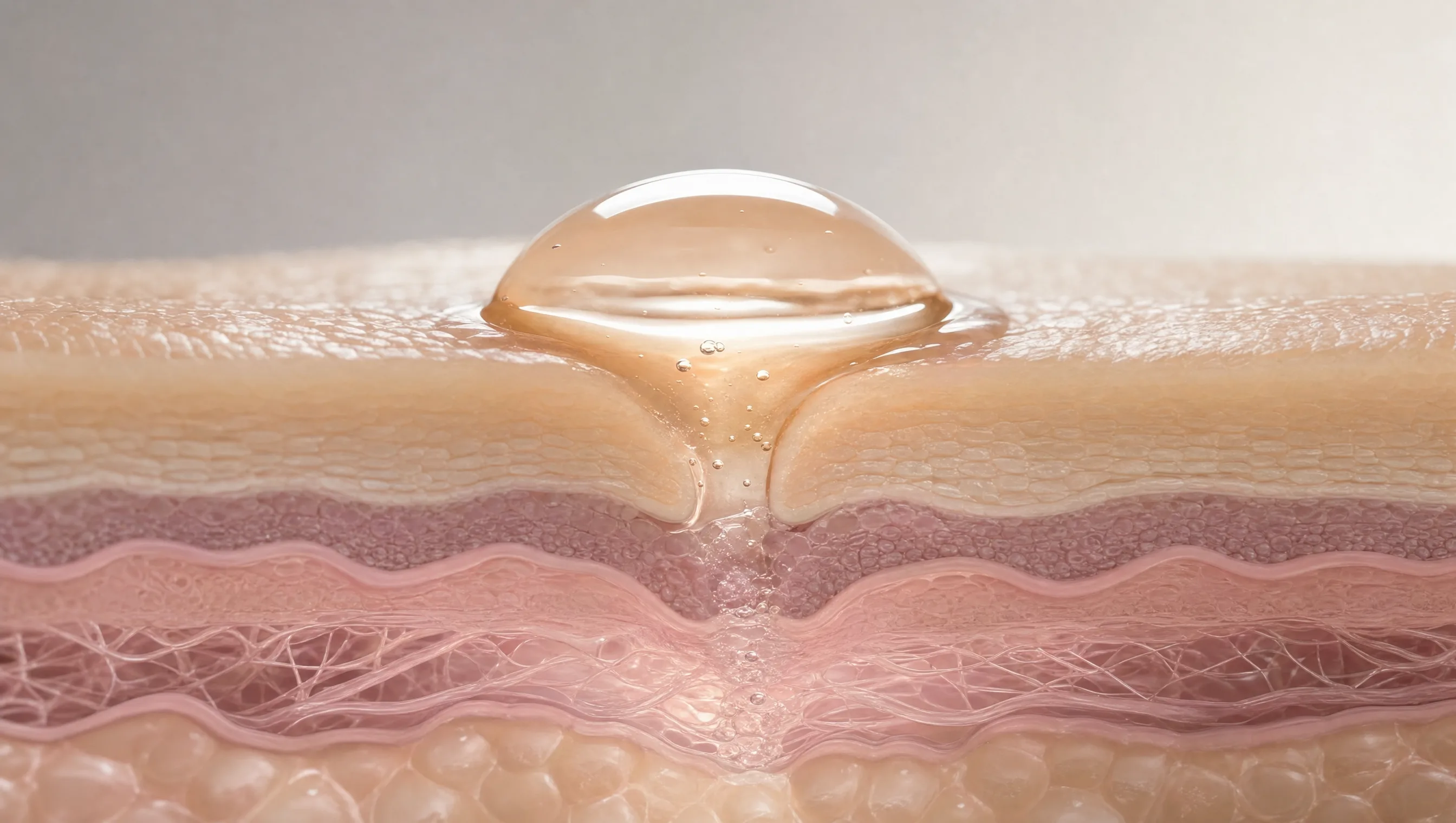
A nicotine patch and a moisturiser both sit on your skin. One is engineered to deliver a drug into your bloodstream; the other is engineered to hydrate your stratum corneum and go no further. That distinction — transdermal versus topical — is fundamental to understanding what different products can actually achieve, and skincare marketing blurs it constantly, implying cosmetic-level penetration that would technically make a product a drug.
The basic definitions
Topical delivery means a product works at or near where it’s applied — the goal is a local effect. A moisturiser hydrating the stratum corneum, an anti-acne treatment targeting bacteria in a pore, an antifungal cream treating a localised infection: all topical.
Transdermal delivery means a product is applied to skin but designed to move active ingredients into systemic circulation — your bloodstream — for effects throughout the body, not just at the site of application. Nicotine patches, hormone patches and fentanyl patches are transdermal.
The physical act of crossing skin is broadly similar in both cases. What differs is intent, engineering, and — as a direct consequence — regulatory classification.
Why the depth question matters
Topical products are generally designed to stay in the stratum corneum (moisturisers, sunscreens), penetrate into the epidermis (most active skincare), or occasionally reach the upper dermis (some prescription treatments). Transdermal products are designed to cross every skin layer, enter dermal capillaries, and achieve blood levels high enough to have a therapeutic effect elsewhere in the body.
These are genuinely different engineering problems. A retinol serum succeeds if it reaches fibroblasts in the dermis and stimulates collagen production locally — see our piece on the 500 Dalton rule for why molecular size decides which ingredients can even attempt that journey. A nicotine patch only succeeds if it delivers nicotine into the bloodstream at a rate that manages withdrawal symptoms systemically. Neither is trying to do the other’s job.
Why getting a drug transdermal is so hard
Delivering a drug across skin into systemic circulation at a therapeutic dose is a genuine pharmaceutical challenge, not a marketing hurdle. Skin evolved specifically to block systemic absorption of environmental substances, and the stratum corneum does that job well — most molecules simply don’t make it through in meaningful amounts. Transdermal products also typically need to sustain steady drug levels over hours or days, which requires real controlled-release engineering, and they need to hit a precise therapeutic window: too little and nothing happens, too much and it’s toxic. That combination of requirements is why only a narrow list of drugs are suitable candidates — potent enough to work at doses skin can realistically deliver, lipophilic enough to cross the barrier, and stable enough to survive formulation.
The drugs that have actually made this list are a short one: nicotine (small, lipophilic, effective at low doses — the classic success case), steroid hormones like oestrogen and testosterone, potent opioids including fentanyl and buprenorphine, scopolamine for motion sickness, clonidine for blood pressure, and some hormonal contraceptives. Despite decades of pharmaceutical research, that list isn’t expanding quickly — most drugs simply can’t be delivered effectively through intact skin, however sophisticated the patch technology gets.
Where cosmetics actually sit
With rare exceptions, skincare products are topical, not transdermal, and that’s appropriate — the goals of skincare (hydration, antioxidant protection, collagen stimulation, exfoliation) are local by design. You don’t want a retinol serum delivering retinoids systemically; you want it acting on fibroblasts where it’s applied. When marketing implies a cosmetic product achieves drug-like penetration, that’s not a stylistic exaggeration — the physics doesn’t change because a product is expensive or invokes sophisticated-sounding delivery technology, whether that’s nanoparticles or anything else.
Where regulation draws the line
The topical/transdermal split maps directly onto regulatory categories. Cosmetics are intended to cleanse, beautify or alter appearance, and work topically. Drugs are intended to diagnose, treat or prevent disease, or to affect the body’s structure or function — and transdermal delivery systems are, by definition, drugs. When a skincare product’s claims cross into that territory — genuinely changing skin structure, treating a medical condition, or claiming systemic effects — it risks being misbranded under most regulatory frameworks, and rightly so: drug products are required to prove their delivery and efficacy through rigorous testing, while cosmetics generally aren’t held to the same bar.
A handful of products genuinely sit between the categories. Topical prescription medications — tretinoin, topical steroids, topical antibiotics — are regulated as drugs but act locally rather than systemically, achieving deeper penetration than cosmetics without aiming for the bloodstream. “Cosmeceutical” is a marketing term with no legal definition in most places, describing cosmetics with active ingredients meant to have a biological effect, often marketed with drug-adjacent language despite being regulated as cosmetics. High-concentration actives in professional or prescription settings may reach depths and tissue concentrations that consumer products simply can’t.
What this actually changes about how you shop
Your vitamin C serum isn’t going systemic, and it doesn’t need to — it works in the epidermis and dermis, providing local antioxidant protection and supporting collagen production there. When a cosmetic product claims “deep penetration,” a reasonable reading is “deeper than the very surface” — into the viable epidermis, possibly the upper dermis — not into the bloodstream. Transdermal-style claims for cosmetics are worth treating with real scepticism: if a product claims systemic delivery, ask for the kind of pharmaceutical-grade evidence an actual transdermal drug would need to provide. And a product feeling like it’s sinking in isn’t the same as it reaching systemic circulation — the sensation of absorption and the reality of where an ingredient ends up are two different things.
Common questions
Does “penetrates deeply” ever mean a skincare product is reaching my bloodstream? Almost never — for the small number of exceptions, see the list of genuinely transdermal actives above. Standard cosmetic “deep penetration” claims mean the epidermis or upper dermis, at most.
Are prescription topicals like tretinoin transdermal? No — they’re regulated as drugs because of their strength and the medical claims attached, but they still act locally, not systemically.
Is a product automatically safer just because it’s “only topical”? Not automatically — topical products can still cause irritation, allergic reactions or barrier damage. Topical simply describes where the effect happens, not how mild the product is.
Why this distinction is worth keeping straight
This isn’t semantic hair-splitting — it changes how you should read a claim. Skincare products can genuinely work by targeting skin cells and structures: retinoids act on fibroblasts, vitamin C quenches free radicals in the epidermis, peptides may signal cellular processes. Those are real, local effects worth taking seriously. What skincare products can’t do is achieve pharmaceutical-level systemic delivery through intact skin — and claims implying otherwise are marketing outrunning the chemistry, not a genuine formulation breakthrough.
Skin is an excellent barrier, and that’s a feature rather than a limitation: it’s why environmental toxins don’t easily poison you, and it’s also why your skincare works locally, precisely where you applied it, rather than flooding your system with substances meant to stay on the surface. Transdermal drug delivery is a specialised pharmaceutical achievement with a short list of successes behind it. Topical skincare is a different category, with different goals and different, more modest, capabilities — and when a product promises to work “just like” a transdermal drug, it’s worth asking why it isn’t regulated as one.