Emulsions Explained: Oil-in-Water vs Water-in-Oil
Oil and water don't want to mix — every cream and lotion on your shelf is a small, ongoing chemistry experiment forcing them to. Knowing which type you're using explains a lot about how a product feels, absorbs and layers.
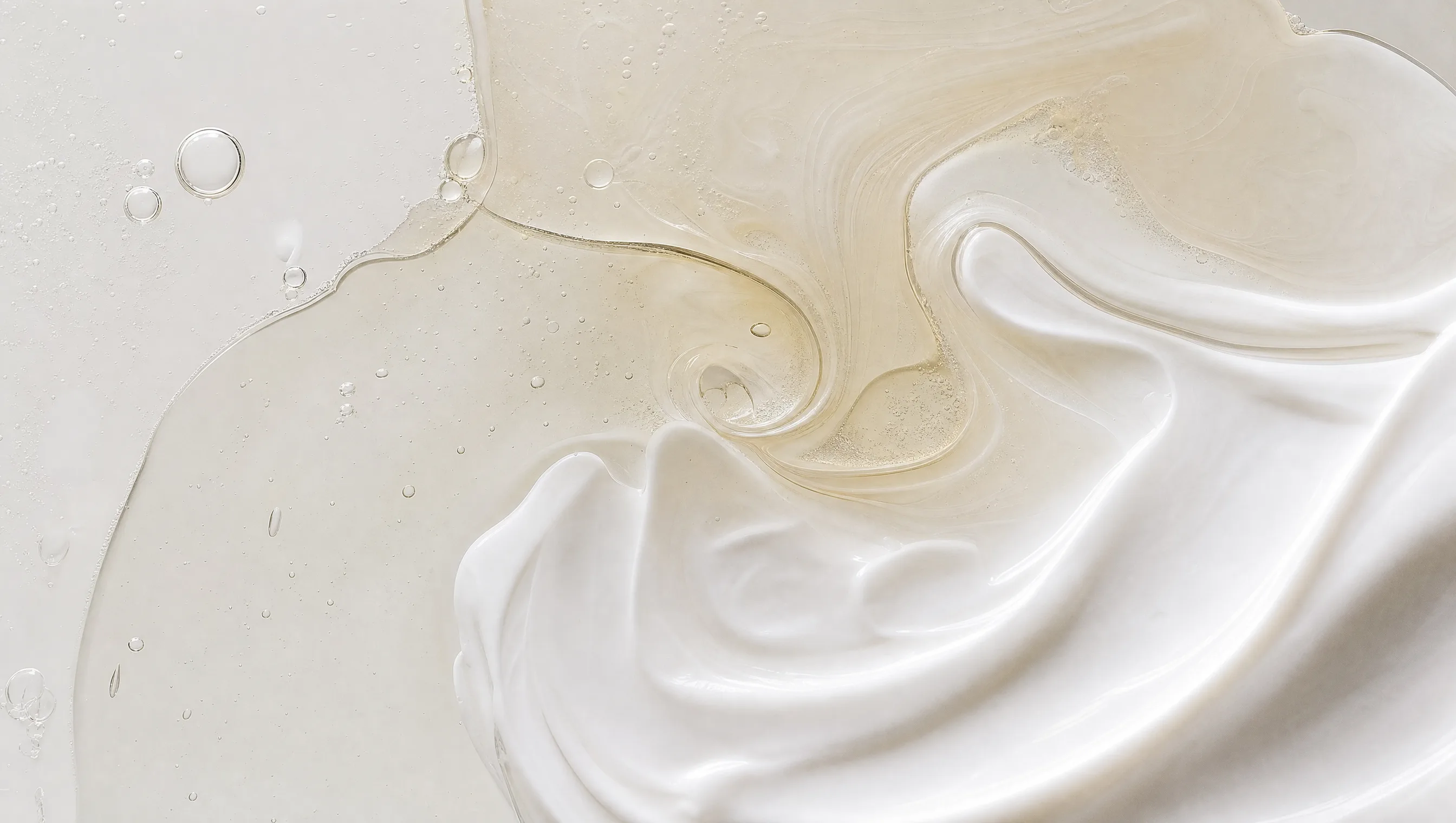
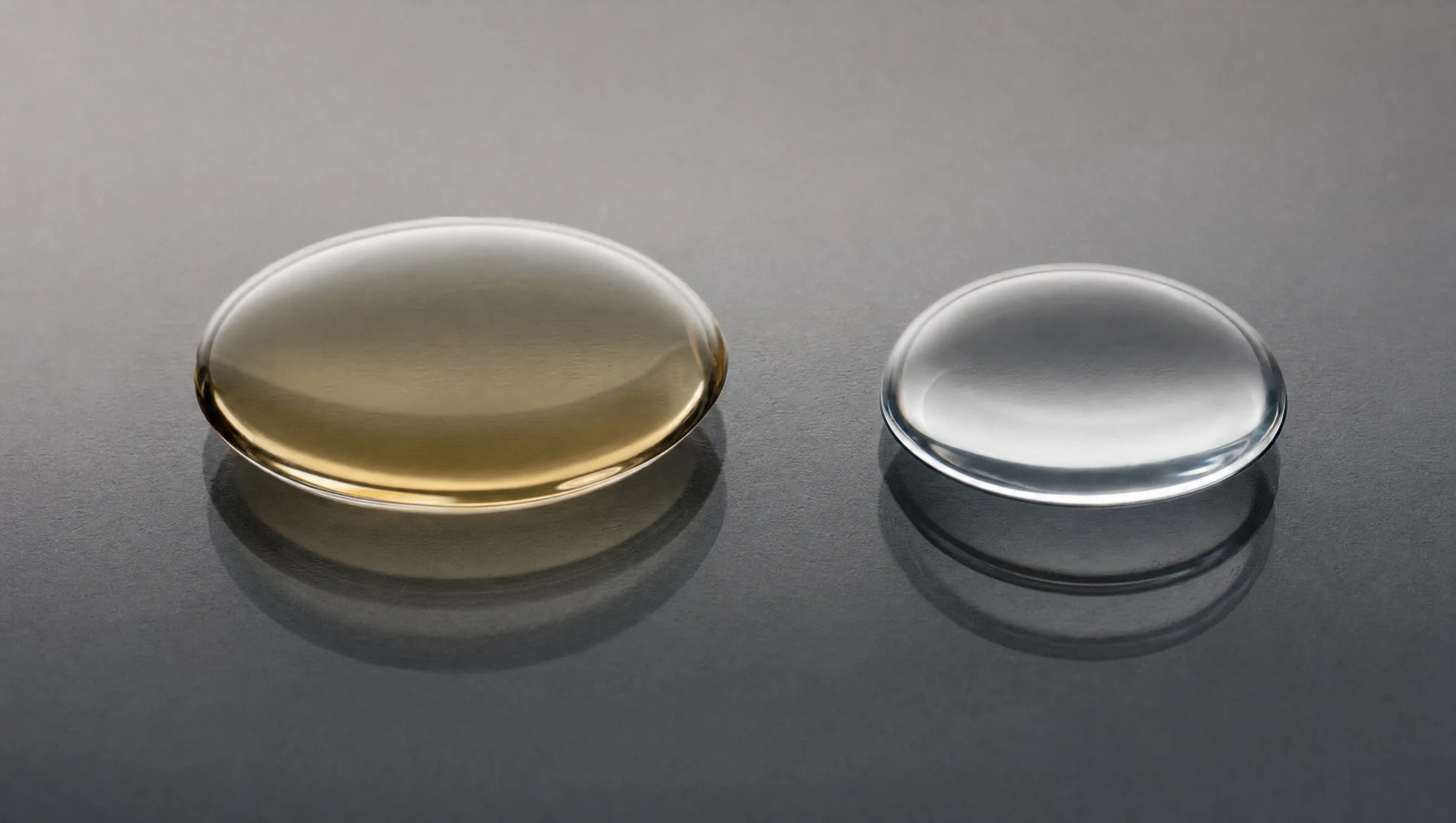
Pour oil into water and it floats. Shake it and it separates again within minutes. Yet most of what’s in your bathroom cabinet — creams, lotions, plenty of serums — is exactly that combination, oil and water, held together in a state neither ingredient wants to be in. That’s an emulsion: a mixture forced into stability by formulation chemistry, not a natural blend. Understanding which type you’re using tells you more about how a product will actually behave than the marketing copy usually does.
The two basic types
Almost every emulsion falls into one of two structures, depending on which liquid surrounds the other.
Oil-in-water (O/W) emulsions disperse small oil droplets through a continuous water phase. Water dominates, which is why these feel light, absorb quickly, and leave little residue once the water evaporates. Most daytime moisturisers, lightweight lotions and sunscreens are built this way.
Water-in-oil (W/O) emulsions do the reverse — water droplets suspended through a continuous oil phase. Oil dominates, so these feel richer and heavier, absorb more slowly, and sit on the skin as a more genuine barrier. Rich night creams, cold creams and some heavy-duty barrier balms are typically W/O.
The distinction isn’t cosmetic detail. Which phase is continuous determines whether a product rinses off with water, how it layers with what comes before and after it, and how much occlusion it actually provides.
Telling the two apart
The ingredient list gives a rough clue: the continuous phase usually appears first, since it makes up the bulk of the formula. Water (aqua) listed first generally signals O/W; oils or fatty alcohols appearing very early — sometimes ahead of water — suggest W/O. It isn’t foolproof, since some O/W formulas use enough oil to push it up the list, but it’s a reasonable starting point.
A quicker test is on your hand. Run water over the product: O/W emulsions wash away easily, while W/O emulsions resist water and stay slightly greasy even when wet. Absorption tells you the same thing from another angle — O/W sinks in with minimal residue, W/O leaves a lasting film.
Matching emulsion to skin, climate and time of day
None of this matters if you can’t connect it to a decision. A few patterns hold up reasonably well:
Oily skin generally gets on better with O/W formulas — enough hydration without added occlusion that can contribute to congestion. Dry skin often needs the extra barrier support that W/O, or a richer O/W, provides; a light O/W lotion alone may not prevent enough moisture loss to feel like it’s doing anything.
Humid climates favour O/W, since skin doesn’t need much additional occlusion to hold onto moisture. Cold, dry climates — or winter generally — tend to call for the heavier barrier support W/O provides.
Daytime routines usually work best with O/W: it sits comfortably under sunscreen and makeup without pilling. Night is where W/O earns its keep, providing intensive occlusion while you sleep and nothing needs to layer neatly on top afterwards.
None of these are rules so much as tendencies — plenty of dry-skinned people are perfectly happy with a well-formulated O/W cream, and some oily-skinned people love a rich night treatment despite the textbook advice against it. Skin doesn’t read the textbook.
Layering logic
Emulsion type affects what goes where in a routine. As a rough order: water-based products absorb well under O/W emulsions, O/W emulsions sit comfortably under sunscreen, and W/O emulsions are usually a final step — anything applied over a W/O layer struggles to absorb properly, since it’s essentially trying to penetrate a film of oil.
If you’re using retinoids, which can be drying, a W/O moisturiser afterwards is a reasonable way to counter that. Multiple W/O products stacked together, on the other hand, mostly just produces excess greasiness and pilling rather than compounding benefit.
What’s actually holding it together
Emulsifiers are the ingredients doing the real work — molecules with one end attracted to water and one attracted to oil, which lets them sit at the boundary between droplets and stop the two phases separating. Cetearyl alcohol and glyceryl stearate turn up in both O/W and W/O systems; polysorbates are common in O/W formulas specifically; lecithin, derived from soy or egg, is a gentler natural option often used in sensitive-skin formulas; beeswax is a traditional W/O emulsifier. The specific system a formulator chooses affects texture, stability and how the finished product feels on skin — it’s not an interchangeable ingredient, and it’s one more example of why formulation changes ingredient results far more than the ingredient list alone suggests.
Beyond the standard two-phase structure, some formulas use nested emulsions — water-in-oil-in-water or the reverse — mainly to separate incompatible ingredients or control release. You’ll mostly encounter these in premium formulations rather than everyday products. Microemulsions, with much finer droplet sizes, appear transparent rather than opaque and may offer some penetration advantage, though claims here should be read with the same scepticism as any penetration marketing.
It’s also worth remembering that not everything oily on your shelf is an emulsion at all. Anhydrous products — facial oils, balms, oil-based serums — contain no water and so aren’t emulsions in the technical sense. They work through pure occlusion and oil-soluble ingredient delivery, which is a different mechanism, not a lesser one.
When emulsions go wrong
Emulsions can destabilise over time — separation, phase inversion (an O/W formula flipping to W/O or vice versa), or creaming where ingredients unevenly settle. Signs include visible separation, a changed texture, an odd smell, or water pooling on the surface. Temperature extremes, contamination, incompatible additions and simple age are the usual causes, alongside formulas that weren’t especially stable to begin with. A destabilised product isn’t reliably doing its job any more and is worth discarding — see our piece on judging when a product has degraded for a fuller picture of what to look for.
Common questions
Is a thicker cream automatically more occlusive? Not necessarily — thickness is partly about emulsifier and thickener choice, not just how much oil is in the formula. A thin-feeling O/W lotion can still deliver real hydration; a rich-feeling cream isn’t automatically W/O.
Can I tell the emulsion type just by looking at the ingredient list? Roughly, yes, using the “which comes first” heuristic above — but it’s an approximation, not a guarantee, especially for concentrated oil-in-water formulas.
Should I switch emulsion types by season? Many people do, and it’s a reasonable habit — lighter O/W in summer, richer W/O or heavier O/W through winter — but it isn’t mandatory if your current product is working year-round.
Does emulsion type affect how well active ingredients work? It can influence delivery and feel, but the active ingredient itself, its concentration and its stability generally matter more than which side of the O/W-versus-W/O line the base sits on.
The bottom line
Emulsion type is a genuinely useful lens for understanding why products feel and perform the way they do — lighter O/W formulas for daytime, oily skin and humid conditions; richer W/O formulas for night, dry skin and harsher climates. It’s a tendency worth knowing, not a rule to follow rigidly. The right emulsion for you is ultimately the one your skin tolerates and responds to, textbook categorisation aside.